The 20-Minute Weekly Review That Keeps a Small Team on Track
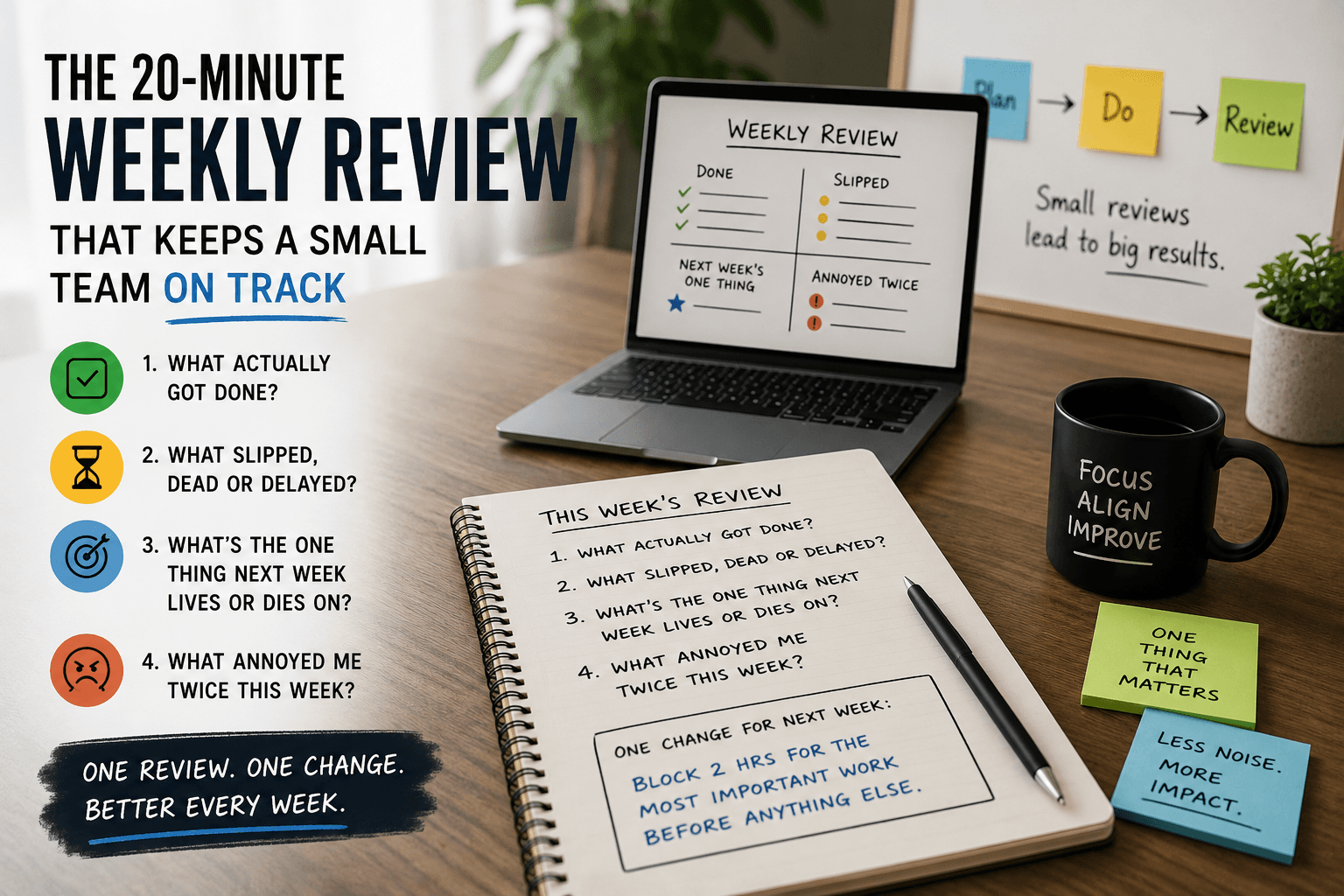
The 20-Minute Weekly Review That Keeps a Small Team on Track
Most weekly review systems collapse for the same reason most diets do: they ask for too much, too often, and the first time you skip one you quietly stop forever.
We have landed on a version that survives busy weeks because it is deliberately small. It takes about twenty minutes, it runs on Friday afternoon or Monday morning depending on your taste, and it needs nothing more than a single document. Here is the whole thing.
Why twenty minutes is the point, not a limitation
A long review feels more responsible. It is not. The value of a weekly review is almost entirely in the habit of stepping back, and a habit that takes an hour gets skipped the moment a week gets heavy — which is exactly the week you needed it most.
So we capped ours. If it ever runs long, that is a signal something is wrong with the week, not the review, and that itself is useful information.
The four questions, in order
Order matters here. We tried other sequences and this one flows best, because each answer sets up the next.
One: What actually got done? Not what was planned — what shipped. Write it down even if it feels small. This question exists partly for morale (busy weeks often produce more than they feel like they did) and partly to calibrate. If the "done" list is consistently shorter than the plan, your planning is too optimistic, and that is fixable.
Two: What slipped, and is it dead or just delayed? This is the question people avoid, so be blunt. For every unfinished thing, pick one word: delayed (still matters, moves to next week) or dead (quietly stopped mattering, let it go). The relief of formally killing a task you were never going to do is underrated. A to-do list full of zombies is heavier than an honest short one.
Three: What is the one thing next week lives or dies on? Just one. Not priorities, plural — the single outcome that, if it happens, makes next week a success even if nothing else does. Naming it now means you protect it later, before the week fills up with other people's urgencies.
Four: What annoyed me twice this week? This is our favorite question and the one nobody else seems to ask. Anything that irritated you two or more times — a clunky handoff, a file you kept hunting for, a meeting that should have been a message — is a system problem wearing a disguise. One annoyance is noise. A repeated one is a process worth fixing. Most of the genuine improvements to how we work started as an answer to this question.
The part most people skip
Here is where reviews usually fail: people answer the questions and then close the document. Nothing changes, so the review feels pointless, so they stop doing it.
The fix is a single rule. Every review has to produce exactly one change for next week. Not five. One. Maybe you block two hours for the "lives or dies" task before anything else gets scheduled. Maybe you fix the annoyance from question four. One concrete change, written as a sentence you will actually see again.
One change a week sounds almost too modest. But fifty small, real changes a year compounds into a way of working that is noticeably better than where you started — and it gets there without a single heroic productivity overhaul.
Doing it as a team without it becoming a meeting
For a small team, the trap is turning this into a status meeting, which is slower and less honest. We avoid that by having everyone answer the four questions in a shared doc before any conversation. Reading takes five minutes; the only thing worth talking out loud about is question three (so the team agrees on the one thing that matters) and any annoyance that more than one person flagged.
If two people independently named the same friction, you have found your one change for the week, and you found it without a meeting that ate the afternoon.
When to change the questions
Treat the four questions as a default, not scripture. If a question stops earning its keep — you always answer it the same way, or it never leads anywhere — swap it. The structure is just a reliable way to make stepping back automatic. The specific questions should bend to the work you actually do.
What should not change is the size. The moment a weekly review feels like a chore is the moment it stops happening, and a small review you actually run beats a thorough one you abandon by February.
If you want a daily-scale companion to this, our guide on using ChatGPT for daily productivity covers the morning-and-evening loop that feeds into this weekly one.
Get Weekly AI + Tech Updates
Receive practical AI tools, workflows, and hand-picked resources in one concise weekly email.
Research & Editorial
AI Tech Minty is an independent publication run by a small editorial team with backgrounds in software, consumer technology, and teaching. We research and test the tools and products we cover, write and edit every guide in-house, and review each article for accuracy before it is published. Our focus is practical, no-hype guidance our readers can act on the same day.