Best AI Image Generation Tools in 2026: Midjourney, FLUX, Ideogram and More Compared
Best AI Image Generation Tools in 2026: Midjourney, FLUX, Ideogram and More Compared
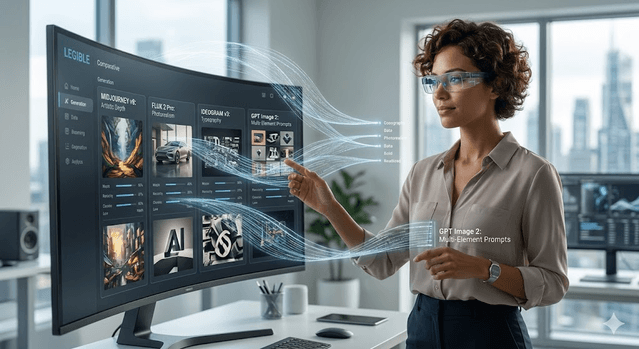
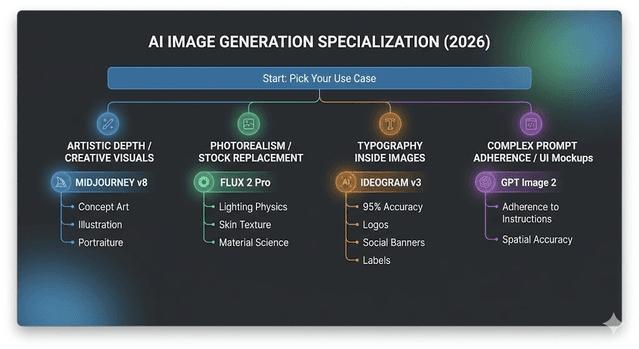
The AI image generation market in 2026 has fractured in the most useful way possible. Instead of one tool trying to do everything, the field has specialized. Midjourney leads for artistic aesthetics. FLUX 2 Pro leads for photorealism. GPT Image 2 leads for prompt accuracy and text rendering. Ideogram v3 leads for typography inside images. Adobe Firefly leads for commercial safety.
This specialization is good news for creators, designers, and marketers. It means you can choose the tool built specifically for your use case rather than settling for a compromise. The challenge is knowing which tool that actually is — and this guide answers that question clearly.
Over 15 million AI-generated images are created daily as of 2026. The technology has reached a level where trained designers genuinely cannot always distinguish AI output from professional photography. The question is no longer whether these tools work. It is which one to use for what.
Why you can trust this comparison
This guide is built around job-to-tool fit, not hype cycles. We rank tools by practical outcomes creators care about: output consistency, prompt reliability, text rendering, commercial-use clarity, and workflow compatibility. Every recommendation includes trade-offs so you can avoid paying for features that do not match your use case.
Evaluation criteria used
Each platform is scored using five decision filters:
- Visual quality for its primary specialty (artistic, photoreal, or layout accuracy)
- Prompt adherence and repeatability across multiple generations
- Text rendering reliability for typography-heavy tasks
- Commercial licensing clarity for published client or brand work
- Workflow fit (API, editor integration, and team collaboration needs)
Quick tool selection table
| Tool | Best For | Typical Cost | Main Limitation | | --- | --- | --- | --- | | Midjourney v8 | Artistic quality and concept visuals | From $10/month | No official API workflow | | FLUX 2 Pro | Photorealism and API-first generation | About $0.05-$0.06/image | Less stylized output by default | | GPT Image 2 | Prompt accuracy and structured layouts | Included in Plus or API pricing | Less signature visual style than Midjourney | | Ideogram v3 | Readable text inside generated images | Free tier + paid from $7/month | Weaker photorealism than FLUX | | Adobe Firefly | Commercial safety and enterprise workflows | Free tier + paid from $9.99/month | Narrower stylistic range | | Google ImageFX | Strong free photoreal output | Free | Watermarked output and lower fine control | | Leonardo.ai | Multi-model experimentation | Free tier + paid from $10/month | Quality varies by chosen model |
How to choose before you read the comparisons
Two questions narrow the field immediately. First: is the image being used for personal creative work, or for commercial publication? Commercial use requires either a platform that grants commercial rights explicitly (Midjourney paid plans, Adobe Firefly, GPT Image 2 via API) or careful review of each platform's terms. Second: does the image need readable text? Most AI image generators still produce garbled or incorrect text inside images. If your use case involves logos, posters, signage, or social graphics with words on them, this question alone points to one tool above all others.
1) Midjourney v8 — Best for artistic quality
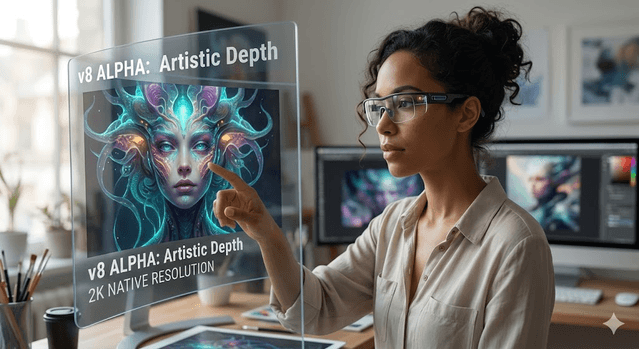
Midjourney v8 Alpha launched in March 2026 with native 2K resolution output, five times faster generation than v7, and the same distinctive aesthetic quality that has made it the benchmark for AI art since the model's early days. For gallery-worthy portraits, cinematic concept art, fantasy illustration, and any use case where visual impact and artistic depth matter most, Midjourney remains the undisputed leader in output quality.
The platform operates through a dedicated web app. Discord remains an option but the web interface has become the primary access point for most users. Character consistency has improved significantly in v8 — you can now maintain a consistent character appearance across multiple generations, which was a significant limitation of earlier versions.
Best for: Illustrators, concept artists, creative directors, and anyone producing high-quality visual art or marketing imagery where aesthetic excellence is the priority.
Pricing: From $10/month for the Basic plan (approximately 200 images/month with commercial rights). Pro plan at $60/month includes private image generation — all images on lower plans appear in the public gallery by default.
Important limitation: No free trial currently available. No direct API access (third-party workarounds exist but violate terms of service). If you need API integration for a product or workflow, Midjourney is not the solution.
2) FLUX 2 Pro (by Black Forest Labs) — Best for photorealism
FLUX 2 Pro has emerged as the strongest photorealism option in 2026, producing results that are often indistinguishable from real photography for product shots, stock photo replacements, and realistic scene generation. The model's handling of lighting physics, skin textures, and material surfaces is the most advanced available.
Unlike Midjourney, FLUX is accessible via API through platforms like Replicate and fal.ai, making it genuinely useful for developers building products that require AI-generated visuals. It is also self-hostable for organizations with GPU resources that want unlimited generation without subscription fees.
Best for: Product photography replacement, stock photo creation, realistic scene generation, and any workflow requiring API access or production-scale generation.
Pricing: Approximately $0.05-$0.06 per image via API. No monthly subscription required — pay per generation. Self-hostable via ComfyUI for teams with hardware.
Watch out for: Less artistic and stylized than Midjourney. If you need a distinctive visual style rather than photographic realism, FLUX is not the strongest choice.
3) GPT Image 2 (via ChatGPT and API) — Best for prompt accuracy and text rendering
OpenAI's GPT Image 2 model is optimized for doing exactly what you describe in your prompt — following complex, multi-element instructions precisely. Where Midjourney interprets prompts creatively (sometimes beautifully, sometimes unexpectedly), GPT Image 2 is more literal and reliable for prompts with specific requirements.
This precision makes it the strongest choice for UI mockups, app screen generation, marketing banners, and any use case where spatial accuracy and prompt adherence matter. The model handles text inside images significantly better than most alternatives, making it competitive with Ideogram for certain text-heavy applications.
Access via the API is clean and well-documented, with standard OpenAI pricing. ChatGPT Plus subscribers get generous access to GPT Image 2 generation through the ChatGPT interface.
Best for: Developers building applications that need reliable image generation from structured prompts. App UI mockups, spatial layouts, and marketing materials with specific elements.
Pricing: API pricing at approximately $0.04-$0.08 per image depending on quality settings. Included in ChatGPT Plus at $20/month.
4) Ideogram v3 — Best for text inside images
If your images need readable words — logos, posters, social media graphics with slogans, signage, product labels, or any creative where typography is part of the design — Ideogram v3 is the only serious option in 2026. While other AI image generators achieve roughly 30-40% text accuracy at best, Ideogram v3 achieves approximately 90-95% accuracy for text rendering inside generated images.
That gap is transformative for marketers, social media managers, and designers creating branded content. The difference between "occasional garbled text that needs manual correction" and "reliable readable text on the first try" fundamentally changes what is practical to produce with AI.
Ideogram is not the strongest choice for pure artistic imagery or photorealism — those are better served by Midjourney and FLUX respectively. Its photorealism is weaker than dedicated tools. But for any use case where the words on the image need to be correct and readable, Ideogram is in a category by itself.
Best for: Marketers and designers creating text-heavy visual content — social media posts, posters, logos, branded graphics, and any image where typography is central.
Pricing: Free tier with approximately 10 prompts per day. Paid plans from $7/month. Excellent value for the specific use case.
5) Adobe Firefly — Best for commercial-safe content
Adobe Firefly is built on training data licensed from Adobe Stock and professional content, with Adobe providing legal indemnification against copyright disputes for commercially used output. For enterprise teams, marketing agencies, and any organization producing images that will be published under a brand — where the legal risk of training data provenance matters — Firefly is the safest choice.
The output quality is strong but not as artistically distinctive as Midjourney, and the range of visual styles is narrower. What Firefly offers that others do not is clear commercial licensing clarity and integration with the broader Adobe creative ecosystem — Photoshop, Illustrator, and Adobe Express can use Firefly-generated content seamlessly within existing professional workflows.
Best for: Enterprise marketing teams, agencies, and organizations where commercial licensing and legal clarity are non-negotiable requirements.
Pricing: Free tier available through Adobe Express. Paid plans from $9.99/month for higher generation limits and full commercial licensing.
6) Google ImageFX (via Imagen 4) — Best free option for photorealism
Google's ImageFX, powered by the Imagen 4 model, produces photorealistic output that competes with many paid tools — and it is free to use with generous daily limits. For individuals and teams that need quick, high-quality image generation without a budget commitment, it is the most impressive free option available in 2026.
The interface is simple and fast. Images generate quickly and the quality is consistently strong for everyday creative needs. The main limitation is the Google watermark (SynthID) on all exports and the lack of fine-tuned stylistic control compared to paid platforms.
Best for: Anyone needing fast, photorealistic image generation without cost. Students, hobbyists, and professionals testing AI imagery before committing to a paid platform.
Pricing: Free, with daily generation limits that reset every 24 hours.
7) Leonardo.ai — Best for creators wanting multiple models
Leonardo.ai (now owned by Canva) provides access to a wide range of image generation models from a single platform — including FLUX, its own Phoenix and Lucid Origin models, and community fine-tuned models. This model flexibility makes it particularly useful for creators who work across different styles and want to experiment without managing multiple platform subscriptions.
The Canvas Editor provides post-generation editing capabilities that most pure generation tools lack. The free tier is genuinely useful, offering 150 tokens daily.
Best for: Creators who want access to multiple models from one interface. Game designers, digital artists, and content creators who produce diverse visual styles.
Pricing: Free tier with 150 daily tokens. Paid plans from $10/month for higher generation limits and commercial licensing.
Free vs. paid: making the right call
For most everyday creative use — blog images, social posts, personal projects, and exploration — free tools including Google ImageFX and Leonardo.ai's free tier are genuinely capable. Paid plans become worth the investment when your use case requires consistent commercial rights, higher generation volume, specific quality tiers, or API access.
The most common error is subscribing to the wrong tool for your specific use case. Someone who primarily creates social media graphics with text should be on Ideogram, not paying for Midjourney. Someone building a product that requires image generation via API should be on GPT Image 2 or FLUX, not a Discord-based platform. Someone producing luxury brand photography should consider FLUX or Midjourney. Match the tool to the actual job before committing financially.
A practical toolkit for most creators
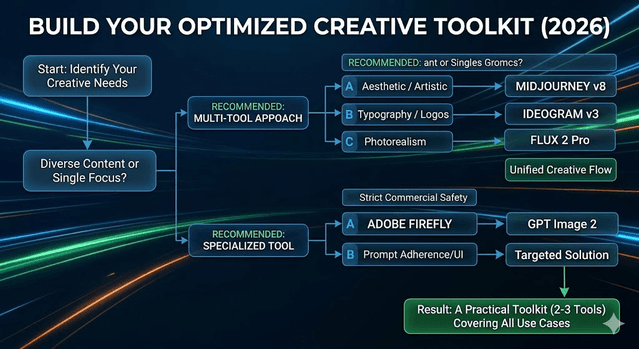
Rather than choosing one tool exclusively, most professionals maintain a small toolkit of two or three platforms for different jobs. A typical setup in 2026: Midjourney or FLUX for high-quality creative imagery, Ideogram for any content requiring readable text, and Google ImageFX or Leonardo.ai for quick generation and experimentation.
This combination covers virtually every image creation need without excessive subscription overlap. Total monthly cost for this toolkit is $20-$30 — less than many single software subscriptions — and the quality delivered exceeds what a stock photography subscription could provide for most use cases.
The ethical and legal landscape
Copyright questions around AI-generated images remain partially unsettled. For individual creative use and most social media content, the legal environment is permissive and no specific legislation restricts publication of AI-generated imagery as of 2026. For large-scale commercial campaigns, products that incorporate AI imagery at the core of the brand, and enterprise applications, Adobe Firefly's clear licensing structure offers the most legally defensible position.
All major platforms have implemented content moderation to prevent generation of harmful, sexually explicit, or privacy-violating content. This moderation affects some legitimate creative work — pharmaceutical, medical, and mature-but-legal creative use cases sometimes encounter restrictions. Locally-run open-source tools like FLUX via ComfyUI avoid platform content moderation for creators who find those restrictions limit legitimate work.
Choose the tool that fits your technical requirements, budget, and use case. Start with a free tier or trial period, test it against your actual creative needs, and subscribe only when the quality and features demonstrably serve your work.
Common selection mistakes to avoid
- Choosing a tool based on popularity instead of your exact output type
- Ignoring licensing terms until after client work is published
- Expecting one model to handle both photoreal product shots and typography-heavy branding equally well
- Paying for multiple overlapping subscriptions before validating workflow fit
Get Weekly AI + Tech Updates
Receive practical AI tools, workflows, and hand-picked resources in one concise weekly email.
AI & Software Writer
Akash Kumar is a software engineer with a master's degree in computer science. He writes about AI tools, software development, and emerging tech, drawing on his engineering background to test new AI products hands-on and explain how they fit into real development workflows for developers, students, and creators.