
Quantum Computing Explained Simply: What It Is and Why It Matters in 2026
Quantum Computing Explained Simply: What It Is and Why It Matters in 2026
If you have heard the phrase "quantum computing" and mentally filed it under "things that sound important but will never affect me," 2026 is a good year to revisit that assumption. Quantum computing has crossed a critical threshold. It is no longer purely theoretical, and it is no longer only relevant to physicists working in government labs. Real hardware exists. Commercial cloud access is available. And the first applications that produce measurably better results than traditional computers are within reach.
This guide explains quantum computing in plain language — no physics degree required — and covers what is actually happening in the field right now.
What is quantum computing, and why does it matter?
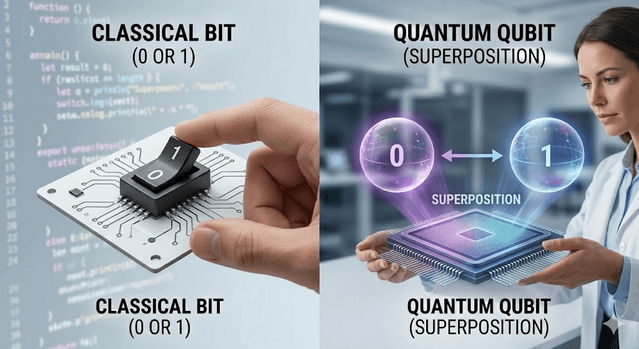
A conventional computer — your laptop, your phone, the server running your favorite app — processes information as bits. Each bit is either a 0 or a 1. Everything a computer does, from loading a webpage to running a spreadsheet, reduces to sequences of these binary decisions happening billions of times per second.
A quantum computer uses a fundamentally different unit: the qubit. Unlike a classical bit, a qubit can exist in multiple states simultaneously. Think of it like a spinning coin that is both heads and tails at the same time — until you look at it. This property, called superposition, allows quantum computers to explore enormous numbers of possible solutions in parallel rather than checking them one at a time.
The second key property is entanglement. When two qubits are entangled, the state of one instantly influences the state of the other, regardless of the distance between them. This allows quantum computers to coordinate calculations in ways that classical computers cannot replicate.
Together, superposition and entanglement give quantum computers extraordinary speed advantages for specific types of problems — particularly ones that involve searching through vast possibilities or simulating complex physical systems.
What problems can quantum computers actually solve?
Quantum computers are not better at everything. They will not browse the web faster, load apps quicker, or run word processors more efficiently. Their advantage is narrow but enormously valuable in specific domains.
Drug discovery and medicine. Simulating how molecules interact at the atomic level is something classical computers struggle with deeply. Even simple molecules require astronomical computing resources to model accurately. Quantum computers can simulate molecular behavior in ways that are simply not feasible with traditional hardware, potentially cutting years off the drug development process and delivering breakthrough treatments to patients faster.
Optimization problems. Many real-world challenges come down to finding the best option among an enormous number of possibilities — routing delivery trucks, managing financial portfolios, scheduling airline operations, optimizing supply chains. Quantum algorithms can evaluate many possibilities simultaneously, producing better solutions faster.
Cryptography and security. This one cuts both ways. A powerful enough quantum computer could break widely used encryption systems that protect internet traffic and financial transactions. At the same time, quantum computing enables entirely new forms of cryptography that would be effectively unbreakable. Organizations worldwide are already preparing by developing post-quantum encryption standards.
Materials science and energy. Understanding how materials behave at the quantum level could unlock better batteries, more efficient solar cells, new semiconductors, and improved catalysts for industrial processes. These advances ripple outward into climate solutions and manufacturing efficiency.
Where does quantum computing stand in 2026?
The honest assessment of 2026 is this: quantum computing has moved from theoretical promise to early practical reality, but it has not yet delivered the dramatic, world-changing applications that were sometimes predicted.
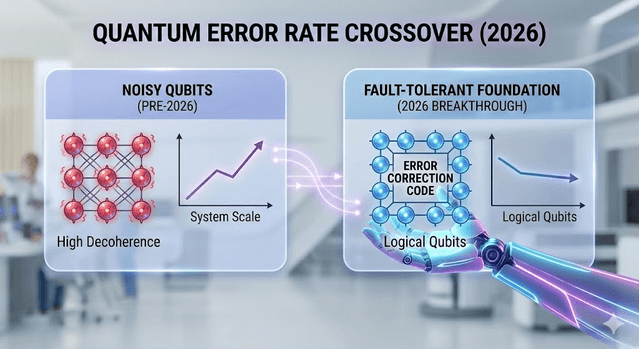
The field has entered what researchers describe as the "fault-tolerant foundation era." For years, adding more qubits to a quantum processor also added more errors — noise that corrupted calculations. The major milestone of 2026 is crossing the threshold where adding more qubits can actually reduce the error rate rather than amplify it. That reversal is critical because it means scaling quantum hardware now produces more reliable results rather than less.
IBM has been building out its quantum computing roadmap steadily, and expects to demonstrate clear quantum advantage — cases where quantum genuinely outperforms all known classical approaches — by late 2026. Google's Willow chip demonstrated significant progress in reducing errors while scaling. Microsoft has been working on a different approach using Majorana-based qubits, which in 2026 showed clearer experimental control than in previous years.
Multiple research teams also demonstrated functioning metropolitan quantum networks in 2026 — quantum communication links running over real city infrastructure, not just laboratory cables. This is a step toward the vision of a "quantum internet" that could enable secure communications at a new level.
What does quantum computing look like physically?
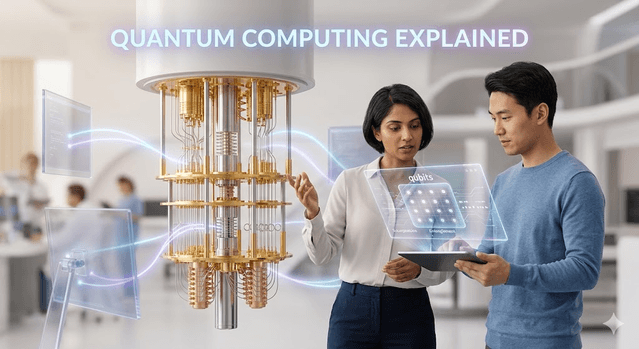
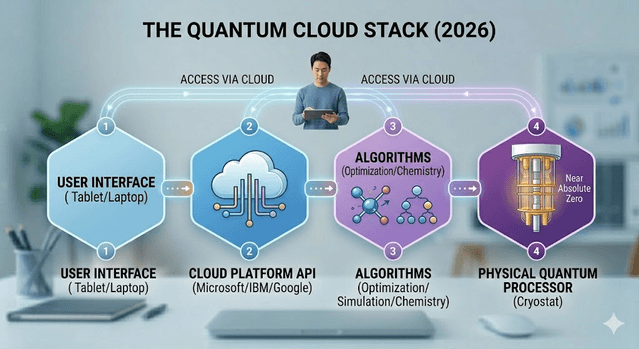
Quantum computers look nothing like the devices you use every day. Most current systems are enormous machines housed in carefully controlled environments. At the center of many systems is a tall cylindrical device called a cryostat that cools the quantum processor to temperatures near absolute zero — colder than outer space — because qubits are extremely fragile. Any heat, vibration, or electromagnetic interference can disrupt the quantum states and corrupt calculations.
This fragility is the central engineering challenge. Researchers call it decoherence: the tendency of qubits to lose their quantum properties when disturbed by the environment. Most of the engineering work in 2026 has focused on keeping qubits stable long enough to complete useful calculations.
Access to quantum computers for most researchers and developers happens through cloud services. IBM Quantum, Google Quantum AI, Amazon Braket, and Microsoft Azure Quantum all allow users to run programs on real quantum hardware via the internet. You do not need your own quantum machine to experiment with the technology.
Who is building quantum computers?
The investment landscape in quantum computing has grown dramatically. The major players fall into two categories: large technology companies with long-term research programs, and startups focused on specific hardware or software approaches.
IBM has been one of the most transparent players, publishing a detailed roadmap and giving cloud access to researchers globally. Google has made headline advances including demonstrations of computational tasks that would take classical supercomputers vast amounts of time. Microsoft is pursuing a different hardware approach based on topological qubits, which could be more stable if the technology matures as hoped. Amazon and other cloud providers have positioned themselves as neutral platforms giving customers access to hardware from multiple vendors.
Startups like IonQ (trapped-ion qubits), Quantinuum, Rigetti, and QuEra are each betting on different underlying technologies. The competition is genuinely pushing progress faster.
Governments are also major investors. The United States, European Union, China, India, and several other nations have committed billions to quantum research, viewing it as critical national infrastructure for long-term economic and security competitiveness.
What does this mean for everyday people?
Most people will experience quantum computing the way they experience other foundational technologies — through its effects on products and services rather than by using quantum hardware directly. Better medicines, stronger encryption, more efficient logistics, smarter materials: these improvements will flow from quantum research even if you never think about qubits.
The one domain where quantum computing intersects directly with everyday digital life is security. The arrival of powerful enough quantum computers would break the encryption that protects online banking, private messages, and government records. This is why organizations like NIST (the US National Institute of Standards and Technology) finalized post-quantum encryption standards in 2024, and why 2026 is seeing significant investment in migrating existing systems to quantum-resistant cryptography. If you handle sensitive data or work in technology, this transition is worth following closely.
Should you learn quantum computing?
For most professionals, the practical answer in 2026 is: understand the basics well enough to know when it becomes relevant to your field, but do not abandon your current skills to specialize in quantum unless you are in research, advanced cryptography, chemistry, or a related technical field.
If you are curious to go deeper, IBM Quantum offers free educational resources and cloud access to real quantum hardware. Microsoft and Google also publish learning materials. The programming frameworks — Qiskit (IBM), Cirq (Google), and Q# (Microsoft) — are documented publicly.
The field is developing fast enough that a basic literacy now will pay dividends when quantum applications begin reaching commercial maturity, which most experts estimate will happen meaningfully over the next three to five years.
Final thoughts
Quantum computing is real, it is progressing faster than its skeptics expected, and 2026 represents a genuine inflection point where foundational hardware challenges are being solved rather than merely worked around. The technology will not replace classical computers — it will work alongside them, handling the specific classes of problems that are currently out of reach.
The most important takeaway for curious observers is this: the field has left the "perpetually five years away" phase. The breakthroughs happening now are building real infrastructure. When quantum computing does begin delivering transformative applications in medicine, security, materials, and optimization, the groundwork being laid in 2026 will be what made it possible.
Get Weekly AI + Tech Updates
Receive practical AI tools, workflows, and hand-picked resources in one concise weekly email.
AI & Software Writer
Akash Kumar is a software engineer with a master's degree in computer science. He writes about AI tools, software development, and emerging tech, drawing on his engineering background to test new AI products hands-on and explain how they fit into real development workflows for developers, students, and creators.