How AI Is Transforming Personal Finance in 2026: Tools, Tips, and What to Watch

How AI Is Transforming Personal Finance in 2026: Tools, Tips, and What to Watch
Managing money used to mean spreadsheets, monthly bank statements, and occasional visits to a financial advisor. In 2026, that experience looks completely different. AI tools now track spending in real time, predict upcoming expenses, flag unusual charges before you notice them, and offer personalized guidance that was once only available through paid professional advice.
The transformation is real and measurable. A growing number of people now consult AI tools before meeting their financial advisors — and in some cases, instead of them. The tools have matured to the point where they can reason across your full financial picture: income, spending, debt, investments, and long-term goals all in one view.
This guide explains what AI personal finance tools can actually do in 2026, which ones are worth using, and how to avoid the common mistakes that undermine results.
Why you can trust this guide
This comparison focuses on practical financial behavior outcomes: cash-flow clarity, budgeting consistency, investment decision support, and tool safety basics. Recommendations are organized by user profile and workflow fit rather than feature marketing.
Tool selection criteria
Each platform is evaluated by:
- Accuracy and usefulness of transaction categorization and insights
- Ability to connect multiple accounts into one clear financial view
- Support for your financial stage (budgeting, investing, household planning)
- Privacy and security clarity (read-only access, authentication, data handling)
- Cost-to-value based on weekly usage behavior
Quick platform fit table
| Tool | Best For | Typical Cost | Main Limitation | | --- | --- | --- | --- | | Origin | All-in-one financial overview | Paid subscription | May be more than needed for simple budgeting | | Copilot Money | Apple-first personal finance workflow | Paid | Not available for Android users | | Monarch Money | Couples and shared household finances | About $9.99/month | Less ideal for purely solo lightweight tracking | | Cleo | Beginner-friendly conversational budgeting | Free to paid tiers | Limited depth for long-term investment planning | | YNAB | Discipline-focused budgeting behavior change | About $14.99/month | Requires consistent active budgeting habits | | Magnifi | AI-assisted investment research | Free + premium tiers | Not a full autonomous portfolio manager |
What AI Can Do For Your Money
The most useful AI finance applications go well beyond basic expense tracking. Modern tools use machine learning to categorize transactions automatically, detect patterns in your spending over months or years, predict when you might run short before payday, and identify forgotten subscriptions quietly draining your account.
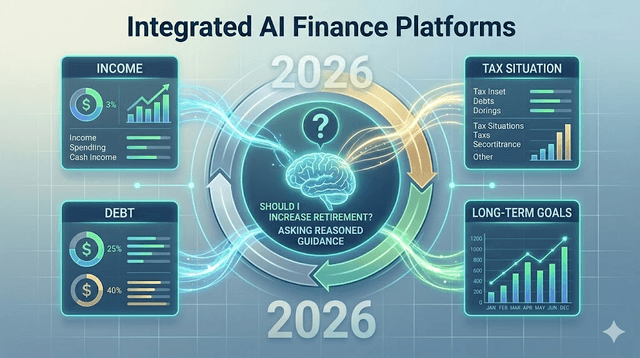
The best platforms also connect across accounts. Instead of logging into separate apps for your checking account, savings, credit cards, brokerage, and retirement fund, integrated AI platforms pull everything together into a single view and give guidance that reflects your complete financial situation.
This is the key shift: AI personal finance moved from passive record-keeping to active guidance. It is the difference between showing you that you overspent on dining last month and explaining why, predicting next month's cash flow, and suggesting where to redirect that $200 surplus.
The Best AI Finance Tools in 2026
Origin — Best All-in-One Platform
Origin stands out as the most comprehensive AI financial platform available. It combines budgeting, investing insights, financial planning, and long-term forecasting in a single system. Instead of treating each financial category as a separate problem, Origin builds a unified picture and provides guidance that accounts for all of it together.
Ask it something like "Should I increase my retirement contribution?" and it evaluates your current cash flow, existing debt, tax situation, and long-term projections before answering — not just looking at one piece in isolation.
Best for: People who want a complete financial command center Pricing: Paid subscription with partner access included
Copilot Money — Best for iPhone Users
Copilot is widely regarded as the most polished personal finance experience for Apple users in 2026. Its AI categorization engine learns from your corrections quickly and gets transaction categories right within weeks — eliminating the manual cleanup that makes most budgeting apps frustrating.
A standout feature added in 2026 is AI-generated monthly summaries: plain-language paragraphs that explain where your money went, what changed from the previous month, and which subscriptions might be worth canceling based on actual usage patterns.
Best for: iPhone and Mac users who want minimal-friction money management Note: iOS and Mac only — not available on Android
Monarch Money — Best for Couples
Monarch solves a specific problem that most finance apps ignore: shared finances between partners. It gives two people a complete shared financial dashboard, real-time updates, and collaborative budget management without requiring them to share login credentials across every individual account.
For couples managing a household budget together, Monarch's collaborative design makes it the clearest choice available.
Best for: Couples and households managing shared finances Pricing: $9.99/month
Cleo — Best for Younger Users
Cleo brings a conversational, personality-driven approach to budgeting. Its chat interface feels less like a financial dashboard and more like texting a knowledgeable friend. It handles basic budgeting, automated savings, and spending analysis with enough accessibility to lower the psychological barrier for people who have historically avoided engaging with their finances.
It is limited in investment planning and long-term modeling, but as an entry point to AI-powered budgeting for users in their 20s and 30s, it is one of the most approachable tools available.
Best for: First-time budgeters and younger users Pricing: Free to $14.99/month
YNAB (You Need a Budget) — Best for Disciplined Budgeters
YNAB's envelope-based budgeting method has attracted a dedicated following for years, and the 2026 version adds meaningful AI enhancements. It remains the gold standard for users who want to actively control every dollar rather than simply track spending passively.
If you find that tracking alone does not change behavior but a structured allocate-first approach does, YNAB consistently delivers results.
Best for: Users who want a disciplined, proactive budgeting system Pricing: $14.99/month
Magnifi — Best for Investment Research
Magnifi is an AI-powered investment search engine that lets you ask plain-language questions like "What are some low-risk dividend ETFs?" and receive structured, data-backed answers. It explains why a fund might suit your goals, flags fee levels and risk factors, and allows you to compare options side-by-side without requiring financial jargon knowledge.
Unlike robo-advisors that manage your portfolio automatically, Magnifi keeps you in control while making you a more informed investor.
Best for: Investors who want AI-assisted research without full automation Pricing: Free and premium tiers available
Robo-Advisors: Automated Investing for Everyone
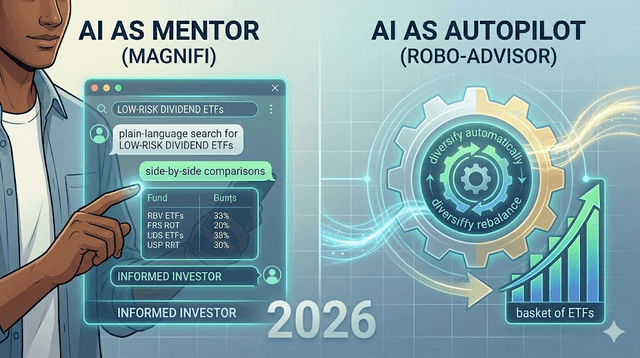
Robo-advisors have expanded dramatically in 2026. Platforms like Betterment and Wealthfront allow anyone to start investing with as little as one dollar. They build a diversified portfolio automatically, rebalance when market conditions shift, and adjust strategy as your goals change.
Robinhood's AI-powered Strategies product takes this further, combining AI guidance with human advisor oversight. It can account for complex situations like stock option-heavy compensation or home-buying timelines — not just placing you in a generic basket of ETFs.
For most people who want to invest without active management, a robo-advisor is a strong starting point.
How to Get Started with AI Finance Tools

The simplest path forward has three steps. First, identify your biggest financial pain point. Is it overspending, lack of investment knowledge, or not knowing your actual net worth? Pick a tool that targets that specific problem rather than the one with the most impressive feature list.
Second, connect your primary bank and credit card accounts first. Verify that the tool pulls and categorizes real transactions accurately before trusting its analysis. Most reputable platforms use read-only connections through trusted aggregators like Plaid, meaning they can see your data but cannot move money.
Third, use the tool consistently for at least six weeks before evaluating it. AI categorization and pattern detection improve significantly as the system learns your habits. Switching apps every few weeks resets that learning process and produces weaker results.
Important Warnings
AI financial tools are powerful but not perfect. They are most useful for budgeting, investment research, and pattern detection. For complex decisions — estate planning, major tax strategy, or significant life transitions — human expertise still adds value that AI cannot fully replace.
Always verify the security certifications and privacy policies before connecting financial accounts. Look for platforms that use read-only connections, bank-level encryption, and two-factor authentication. Do not connect accounts to unfamiliar apps with vague privacy policies.
Also avoid stacking multiple tools that do the same job. More apps means more fragmented data and more effort maintaining everything — the opposite of what you want. One comprehensive platform usually beats three specialized apps.
Scope note
This guide is educational and does not replace licensed financial, tax, or legal advice for high-stakes decisions. Use AI tools for insight and organization, then validate major actions with qualified professionals when needed.
Final Thoughts
AI has closed the gap between the financial guidance available to high-net-worth individuals and what everyone else can access. The tools exist. The question is whether you will use them consistently.
Start with one tool that targets your most pressing financial problem. Connect your accounts. Spend 10 minutes a week reviewing insights. Act on what the data shows. That combination — good tools plus consistent review plus action — produces real financial outcomes. The AI does the analysis. You still have to make the decisions.
Get Weekly AI + Tech Updates
Receive practical AI tools, workflows, and hand-picked resources in one concise weekly email.
AI & Software Writer
Akash Kumar is a software engineer with a master's degree in computer science. He writes about AI tools, software development, and emerging tech, drawing on his engineering background to test new AI products hands-on and explain how they fit into real development workflows for developers, students, and creators.