Best Smart Home Gadgets in 2026: What's Actually Worth Buying
Best Smart Home Gadgets in 2026: What's Actually Worth Buying
Smart home technology has been promising to transform everyday life for nearly a decade. For most of that time, the reality lagged behind the promise — devices that required complex setup, ecosystems that refused to talk to each other, and automations that worked inconsistently enough to make the "dumb" alternative feel easier.
2026 is genuinely different. Three developments have brought smart home technology to a functional maturity that earlier generations of products could not deliver. The Matter protocol has created a common language that allows devices from different manufacturers to work together reliably. AI has moved from gimmick to genuinely useful — thermostats that learn your schedule, cameras that distinguish between a person and a tree branch, robots that can pick up objects rather than just driving around them. And CES 2026 demonstrated a wave of hardware that addresses problems earlier smart home devices ignored.
This guide focuses on what is actually worth buying for most households in 2026 — not the most impressive demos, but the devices that reliably improve daily life.
Before you buy: pick your ecosystem
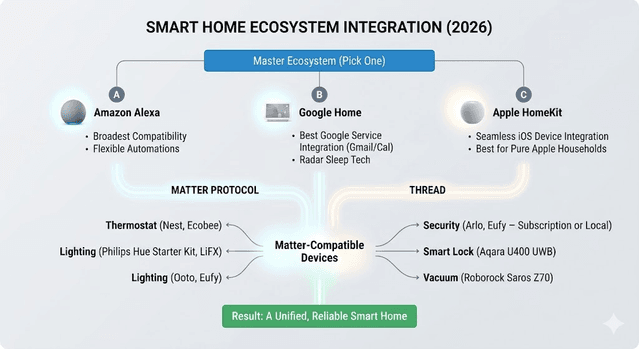
The single most important smart home decision is your ecosystem. The three major platforms — Amazon Alexa, Google Home, and Apple HomeKit — each have different strengths, and mixing them freely creates frustration even with Matter compatibility.
Matter improves cross-ecosystem compatibility meaningfully, but not every feature works across every platform. Voice assistant integrations, automation triggers, and energy management features tend to work most reliably within a single ecosystem. For most households without a strong existing investment, Amazon Alexa is the broadest recommendation — the widest range of compatible devices, the most flexible automation options, and reliable availability at every price point.
Google Home is the better choice for households built around Android devices, Gmail, and Google Calendar. Apple HomeKit is the clearest choice for households where every device is an iPhone, iPad, or Mac.
Choose one and build within it. The frustration of managing multiple ecosystems costs more time than the occasional feature gained from mixing them.
Smart hub: Amazon Echo 4th Gen ($99)
The Amazon Echo 4th Gen remains the recommended starting point for anyone building an Alexa-based smart home. The spherical design, strong speaker quality for its size, and the most consistently reliable Alexa voice recognition available make it the natural control center for everything else.
If you want a display for video calls, recipes, and camera feeds, the Echo Show 10 adds a 10-inch screen that automatically rotates to face you as you move around the room. Its built-in Zigbee hub allows direct control of compatible devices without a separate hub.
For Google-ecosystem households, the Nest Hub at $99 integrates with Calendar, Gmail, and YouTube. Its radar-based sleep tracking feature — which monitors sleep without a camera — is a genuinely useful addition.
Recommendation: Start here. Buy a hub first, then add devices that integrate with it rather than collecting individual devices that may not work well together.
Smart thermostat: Google Nest Learning Thermostat (~$249)
Of all smart home devices, thermostats offer the most straightforward financial case. The Nest Learning Thermostat learns your schedule within approximately one week — when you leave, when you return, when you prefer different temperatures — and adjusts automatically from that point forward.
Google reports average savings of 10-12% on heating bills and 15% on cooling bills for Nest users. At $249, the device typically pays for itself within 18 to 24 months in energy savings, then continues generating savings indefinitely. The US Department of Energy has identified smart thermostats as the highest ROI smart home investment for most households.
Installation requires no professional help for most homes — a screwdriver and 30 minutes is the typical requirement. The Nest app provides clear guidance, and the device itself displays step-by-step setup instructions.
Best for: Any homeowner or long-term renter paying their own energy bills. This is the first smart home device worth buying for most households.
Smart lighting: Philips Hue Starter Kit
Philips Hue remains the benchmark for smart lighting in 2026. The ecosystem includes over 100 products — bulbs, light strips, outdoor fixtures, and accessories — all controlled through a well-designed app and compatible with Alexa, Google Home, HomeKit, and Matter.
The core value of smart lighting goes beyond convenience. Scheduled automations mean lights turn on when you arrive home and off when you leave or go to sleep. Mood lighting — adjusting color and brightness — changes the character of a room without any renovation. Motion-triggered lights in hallways and bathrooms improve nighttime safety without leaving lights on all night.
The Starter Kit (bridge plus two bulbs) is the recommended entry point. Add individual bulbs, light strips, or fixtures gradually as you identify where smart lighting adds the most value in your home.
Best for: Anyone who wants scheduled, automated, or voice-controlled lighting. The ecosystem depth means you can start small and expand without switching platforms.
Smart security camera: Arlo or Eufy
Security cameras are one of the highest-value smart home additions, and the market in 2026 has resolved many of the frustrations of earlier generations — inconsistent motion detection, false alarms from shadows and wind, and poor night vision.
Arlo cameras offer strong image quality, AI-powered person and vehicle detection that significantly reduces false notifications, and wide-angle coverage. The subscription tier provides additional AI features including activity zone customization and package detection.
Eufy cameras offer local storage processing (no mandatory subscription for basic features, which is a meaningful distinction), compatible with Apple Home, and solid build quality. For users who want functional security monitoring without monthly fees, Eufy is the stronger choice.
Ring cameras integrate tightly with Amazon Alexa and benefit from the largest community of Alexa-connected devices. If your hub is an Echo, Ring cameras and doorbells work with the least friction.
Recommendation: Match your camera choice to your hub. Ring for Alexa households, Nest Cam for Google households, and Eufy or Arlo for households prioritizing local storage and no subscription.
Robot vacuum: Roborock Saros Z70
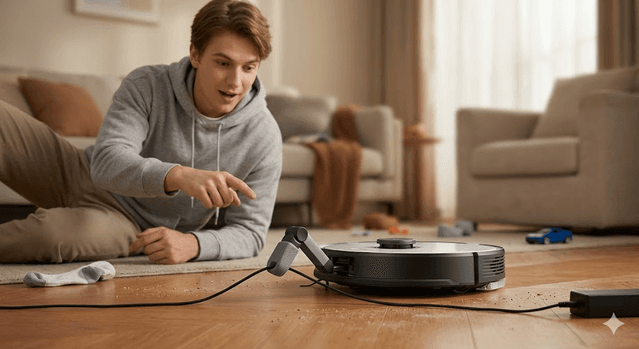
Robot vacuums reached a ceiling a few years ago. They mapped rooms well, avoided obstacles reasonably, and self-emptied. But they all shared a fundamental limitation: if something was on the floor — a sock, a charging cable, a small toy — the robot either got tangled or cleaned around it, leaving a ring of dirt.
The Roborock Saros Z70 addresses this directly with OmniGrip, a retractable robotic arm that picks up lightweight objects before beginning the cleaning cycle. The arm extends from the top of the unit, reaches down with a rubberized grip, and clears small items so the vacuum can clean normally. As of 2026, it remains the only production robot vacuum with this capability.
For households with pets, children, or cluttered floors, this feature eliminates the "pre-robot cleanup" that made earlier robot vacuums a two-step process.
Best for: Busy households where clearing the floor before running the robot was a significant friction point.
Smart lock: Aqara U400 UWB
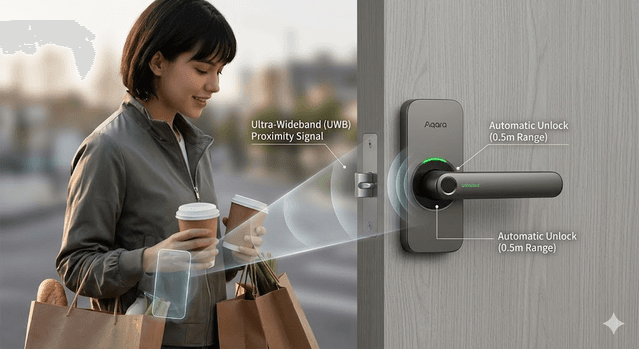
Smart locks have improved substantially in 2026. The Aqara U400 uses Ultra-Wideband (UWB) technology — the same chip in recent iPhones — to detect your precise position as you approach the door and unlock automatically before you reach it. The lock knows which side of the door you are on, preventing accidental unlocks from nearby movement.
It supports fingerprints, NFC, access codes, physical keys, and Apple Home Key. Thread and Matter compatibility means it works without requiring an Aqara hub if you already have a Matter setup. The rechargeable battery is rated for up to six months.
For households dealing with hands-full situations — carrying groceries, children, or equipment — automatic unlocking based on proximity genuinely improves daily life.
Best for: Households already invested in Matter-compatible devices or the Apple ecosystem.
New to 2026: The Lockin V7 Max, announced at CES 2026, eliminates batteries entirely using wireless infrared optical charging — the lock charges continuously as long as the interior module is installed. Expected to ship later in 2026.
Smart lighting automation: Room-aware systems
Beyond individual smart bulbs, room-aware lighting systems in 2026 learn daily routines and adjust automatically based on time of day, activity, and movement patterns. These systems use sensors to detect when a room is occupied versus empty and adjust brightness and color accordingly.
The result is a home that maintains comfortable light levels throughout the day without manual adjustment — brighter, cooler light for focused work in the morning, warmer and dimmer light in the evening, automatic shutoff when rooms have been empty for a set period. Energy savings compound over time.
This category is advancing rapidly. Energy management tools now integrate with solar storage systems and time-of-use electricity pricing to schedule high-power appliances for off-peak periods automatically.
What not to buy yet
Some smart home categories are not yet worth the investment for most households. Smart refrigerators with touchscreens and AI features remain expensive (the GE Profile smart refrigerator announced at CES 2026 starts at $4,899) and the value proposition for everyday households has not been demonstrated convincingly. Smart stoves and ovens with AI cooking features are interesting technology but add complexity without proportional value for most cooks.
Humanoid home robots are technically available in 2026 but remain extremely expensive, have limited practical capability, and are better viewed as early-adopter technology rather than household purchases for most people.
Building your smart home incrementally
The best smart home is not built all at once. The most practical approach is to start with the three highest-return investments — a hub, a smart thermostat, and smart lighting — get comfortable managing and automating them, and add additional devices based on which daily friction points remain.
After the foundation is in place, cameras and smart locks address security. Robot vacuums address cleaning time. Energy management systems address utility costs. Each addition should solve a specific problem rather than adding devices for their own sake.
The smart home technology of 2026 is genuinely reliable in a way that earlier generations were not. Matter compatibility, improved AI, and better hardware design have addressed most of the ecosystem frustrations that made smart homes feel like more trouble than they were worth. The right starting point is simply the device that addresses your most significant daily inconvenience.
Get Weekly AI + Tech Updates
Receive practical AI tools, workflows, and hand-picked resources in one concise weekly email.
Tech Reviews & Productivity Writer
Abhishek is a software engineer with a bachelor's degree in computer science. He covers consumer tech reviews and productivity systems, focusing on real-world comparisons of devices and apps and on practical workflows that help people get more done without buying into hype.