Best Smartphones of 2026: Top Picks for Every Budget
Best Smartphones of 2026: Top Picks for Every Budget
Choosing a new smartphone in 2026 is both exciting and overwhelming. The flagship tier has never been stronger, mid-range phones now punch well above their weight, and AI features have become a genuine differentiator rather than a marketing talking point. Whether you are spending $300 or $1,300, the right choice depends less on raw specs and more on your actual daily use.
This guide breaks down the best smartphones available right now, compared across camera quality, battery life, software experience, and real-world performance using manufacturer specs and published expert reviews — organized by budget so you can skip directly to what matters for your situation.
What actually matters when buying a phone in 2026
Before jumping into specific picks, it helps to know what separates genuinely great phones from overhyped ones this year.
AI integration has moved from novelty to utility. The best implementations in 2026 handle real-time photo enhancement, smart text summarization, and contextual suggestions that actually save time. Weak implementations are little more than chatbot wrappers bolted onto existing apps. Knowing the difference requires hands-on use, not spec-sheet reading.
Battery life has improved dramatically across the board. A 5,000mAh cell was considered flagship territory two years ago. Today, mid-range and even some budget phones ship with 6,000 to 7,500mAh cells, and improvements in efficiency mean those cells last longer per milliamp-hour than older generations did.
Camera systems are increasingly about computational photography rather than hardware alone. The gap between a $400 phone and a $1,200 phone in everyday shooting conditions has narrowed significantly. Where flagship cameras still dominate is in challenging lighting, telephoto reach beyond 3x, and video quality for serious creators.

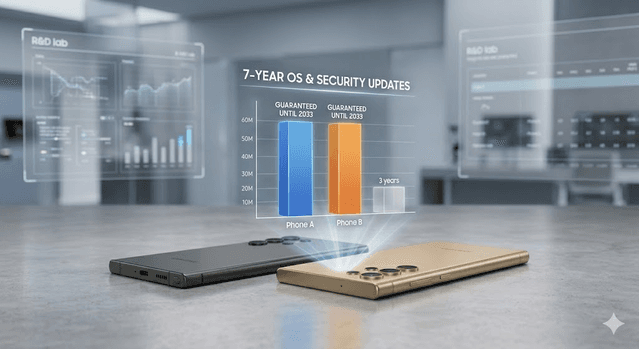
Software support is a factor most buyers underestimate. A phone that receives seven years of OS and security updates is worth more over its lifespan than one with three years of support, even if the hardware is equivalent on day one.
Best overall flagship: Apple iPhone 17 Pro Max
The iPhone 17 Pro Max holds the top spot in 2026 for a combination of reasons that add up rather than a single breakthrough feature. Apple redesigned the camera system with a 48MP triple-camera setup that reviewers consistently rate as setting a new standard for mobile photography. The A19 Bionic chip delivers performance headroom that most users will not exhaust, but the efficiency gains mean real-world battery life that outlasts previous generations.
Design was also refreshed significantly, moving in bold new directions that depart from the boxy look Apple maintained for several years. The starting price of $1,199 held steady from the previous generation, which represents better value given the camera upgrades.
Apple Intelligence features on the iPhone 17 Pro Max include on-device processing that keeps your data private, writing tools across all apps, and photo capabilities like background removal and semantic search through your camera roll. The implementation is more polished than competing platforms in most everyday scenarios.
Who should buy it: Anyone invested in the Apple ecosystem, creative professionals who prioritize camera and video quality, and users who want the longest software support window available.
Best Android flagship: Samsung Galaxy S26 Ultra
Samsung's Galaxy S26 Ultra is the strongest Android flagship of 2026. The Snapdragon 8 Elite Gen 5 for Galaxy processor delivers excellent performance, and One UI has matured into one of the cleanest software experiences in the Android space — including a version of Bixby that reviewers are finally calling genuinely useful.
The standout hardware addition is the world-first privacy display, which can selectively obscure portions of the screen to hide sensitive content from people nearby. For banking, messaging, and professional use, this is a meaningful practical feature, not a gimmick.
Camera performance remains among the best on Android. The S26 Ultra handles low-light shooting, zoom photography, and video recording with consistent quality. Galaxy AI features show particular strength in image editing tasks — in head-to-head comparisons, Samsung's AI editing tools outperformed both Apple Intelligence and Google's Pixel AI in that specific category.
Charging is one area where Android continues to lead Apple. The S26 Ultra supports 60W wired charging and 25W wireless, delivering faster top-ups than the iPhone 17 series.
Who should buy it: Android loyalists who want the best overall package, users who frequently work with sensitive information, and photographers who want flexible AI editing tools.
Best camera phone: Google Pixel 10 Pro
If camera performance and AI capability are your top priorities and you prefer clean Android software, the Google Pixel 10 Pro is the choice. Tensor G5 delivers the most capable on-device AI of any Android phone in 2026 — a conclusion supported by multiple head-to-head comparisons across Apple Intelligence and Galaxy AI.
Photo quality in everyday conditions rivals the iPhone 17 Pro Max. Where Google excels specifically is in computational processing for challenging scenes: heavy shadows, fast-moving subjects, and complex scenes where scene analysis determines the final result. The Pixel 10 Pro also receives seven years of guaranteed OS updates, making it a strong long-term investment.
The Pixel 10 Pro starts at $999, which positions it between Samsung's and Apple's flagship price points while delivering class-leading AI performance.
Who should buy it: AI-feature enthusiasts, Android purists who want stock software and long update support, and users who prioritize computational photography over optical hardware.
Best mid-range pick: OnePlus 15
The OnePlus 15 earned a perfect score from multiple reviewers in 2026, largely because of battery life that several testers described as defying expectations. The combination of a large battery with aggressive efficiency optimization produces results that carry users through full days and into the following morning without anxiety.
Performance is flagship-grade, and the camera system is excellent for the price tier. OnePlus continues to refine its software to balance speed with stability, and the result is a phone that feels premium without a premium price tag.
For users who do not need every cutting-edge feature and want maximum value, the OnePlus 15 is a compelling choice in the $599–$699 range.
Best compact flagship: Oppo Find X9 Pro
The Oppo Find X9 Pro sets itself apart with a camera system that reviewers consistently call one of the best available, and a 7,500mAh battery cell that achieved the highest score in standard battery benchmarking — easily lasting two full days for most usage patterns.
The optional Hasselblad teleconverter kit adds zoom photography capability that surpasses what most smartphones can achieve, making it a serious option for mobile photography enthusiasts. Software support is capped at five years, which is a limitation compared to seven-year commitments from Apple and Google, but hardware quality compensates.
Who should buy it: Photography enthusiasts, heavy users who prioritize battery life above all else, and buyers who want an Android experience that is not Samsung.
Best budget smartphone: Google Pixel 10a
The Pixel 10a with its Tensor G4 chip delivers most of the AI features found in the flagship Pixel 10 line at a significantly lower price. Camera performance outperforms many more expensive devices in everyday conditions. Battery life and display quality have both improved substantially over the previous generation.
For budget-conscious buyers who want capable AI features, reliable cameras, and guaranteed software support, the Pixel 10a represents the clearest value in the market below $500.
Key buying questions before you decide
Rather than chasing the "best" phone in the abstract, answer these three questions before purchasing.
First, how long do you plan to keep this phone? If you hold onto phones for three years or more, software update commitments from Apple and Google matter significantly. Samsung and OnePlus have also extended support commitments in 2026, so compare specific guarantees before assuming.
Second, what ecosystem are you already in? If your laptop is a Mac, your tablet is an iPad, and your earbuds are AirPods, switching to Android creates friction that most reviewers do not discuss because they do not live with the full system. Ecosystem cohesion is a genuine quality-of-life factor.
Third, what do you actually use your phone for most? If it is video streaming, calls, and basic photos, a mid-range phone at $400–$500 will serve you just as well as a $1,200 flagship. If you shoot video for a business, edit photos regularly, or rely on your phone for professional work, the investment in a flagship camera system pays dividends.
Final recommendations by type of buyer
For the all-around best experience: iPhone 17 Pro Max if you prefer Apple, Galaxy S26 Ultra if you prefer Android.
For maximum AI capability on Android: Google Pixel 10 Pro.
For the best value in the mid-range: OnePlus 15.
For the best camera-focused experience: Oppo Find X9 Pro.
For a budget-smart choice with strong AI and camera: Google Pixel 10a.
The smartphone market in 2026 is genuinely competitive at every tier. There are fewer genuinely bad options than there were three years ago. Whichever direction you go, prioritize software support, real-world battery performance, and the ecosystem that fits your existing devices.
Get Weekly AI + Tech Updates
Receive practical AI tools, workflows, and hand-picked resources in one concise weekly email.
Tech Reviews & Productivity Writer
Abhishek is a software engineer with a bachelor's degree in computer science. He covers consumer tech reviews and productivity systems, focusing on real-world comparisons of devices and apps and on practical workflows that help people get more done without buying into hype.